

Exploring the agriculture news of the world
Provided by AGP
Air Pollution Found to Disrupt Insect Communication and Threaten Pest Control Strategies
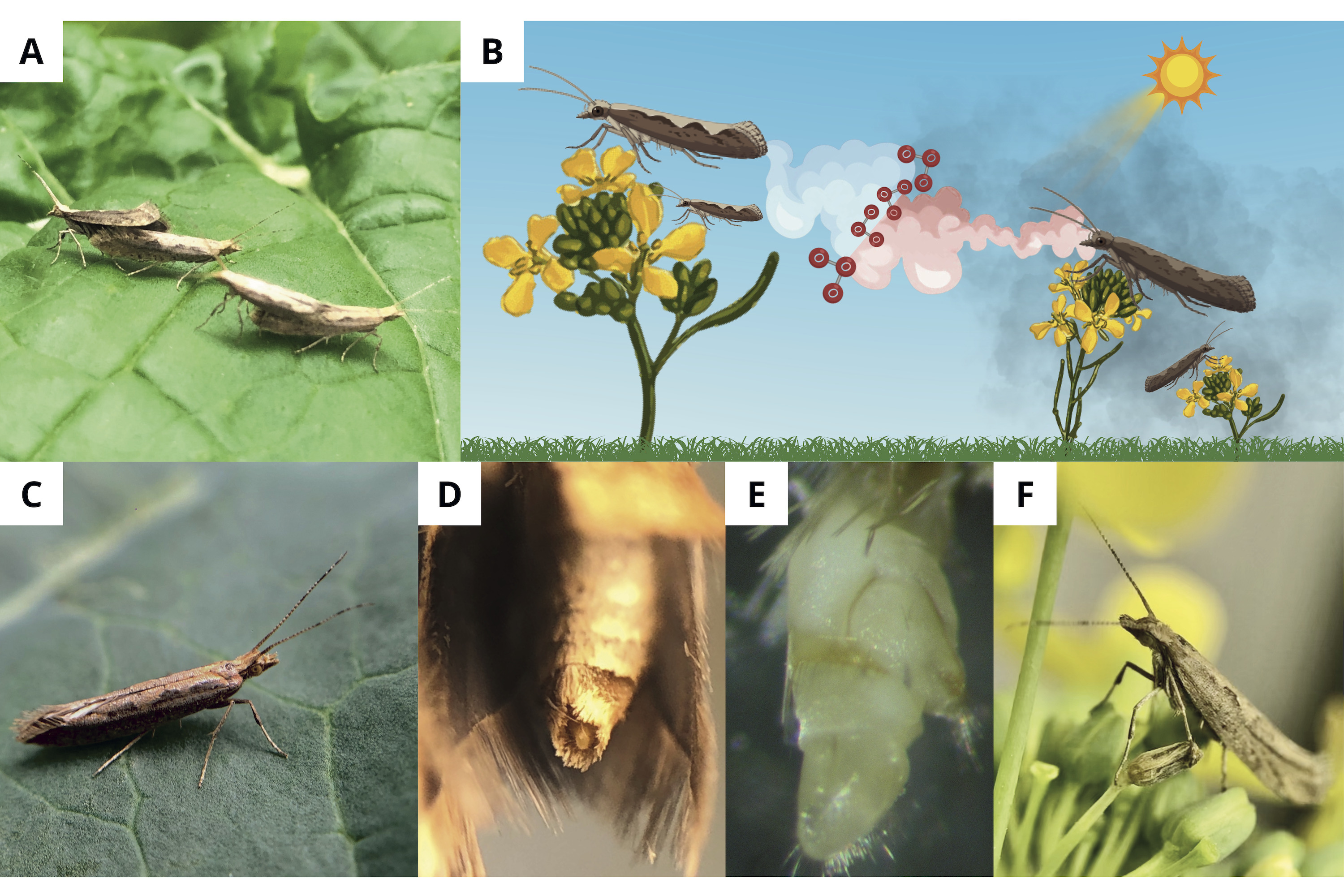
Fig 1: (A) Mating pairs of P. xylostella on a host plant. (B) Schematic representation of pheromone release by a female and its alteration following ozone exposure, leading to reduced male perception. (C) Male P. xylostella. (D) Abdominal region of a fem
Study shows ozone pollution alters moth pheromones, reducing mate recognition and potentially affecting sustainable agriculture.
Air pollution doesn’t just affect air quality, it alters the chemical signals insects rely on for communication”
BEJING , CHINA, May 21, 2026 /EINPresswire.com/ -- A new study has found that air pollution can disrupt insect communication by chemically altering the pheromones insects use to find mates. The findings suggest rising ozone pollution could affect insect reproduction and reduce the effectiveness of pheromone-based pest control strategies widely used in agriculture.— Francesco Sorrentino
Researchers studied the diamondback moth, Plutella xylostella, one of the world’s most damaging crop pests. Female moths release a precise blend of pheromones to attract males, but the study showed that exposure to realistic ozone levels rapidly degraded these chemical signals.
Laboratory experiments revealed that ozone reacts with pheromone molecules through oxidation, changing both their quantity and chemical balance. Male moths responded strongly to pheromones in clean air, but showed much weaker attraction after ozone exposure. In some cases, they could no longer distinguish the pheromone signal from clean air.
The researchers also found evidence that ozone may interfere with pheromone production inside the insects themselves, potentially through oxidative stress affecting key biosynthetic pathways.
The findings are significant because many sustainable pest management methods, including mating disruption and pheromone trapping, depend on stable pheromone signals in the environment. Since pheromone communication is common across many insect species, similar effects may occur more broadly in ecosystems.
About the Research Group:
The study was conducted at the University of Eastern Finland by the Environmental Ecology Research Group (EERG-UEF), which studies chemical ecology and the effects of environmental stressors on ecological communication.
Researchers say the work highlights how atmospheric pollution may influence insect behaviour, crop protection, and ecosystem dynamics as ozone levels continue to fluctuate with climate change.
Read the full article here: https://onlinelibrary.wiley.com/doi/10.1111/1744-7917.70301
Andrew Smith
Charlesworth Yansci
+44 7478 953600
marketing@charlesworth-group.com
Visit us on social media:
X
Legal Disclaimer:
EIN Presswire provides this news content "as is" without warranty of any kind. We do not accept any responsibility or liability for the accuracy, content, images, videos, licenses, completeness, legality, or reliability of the information contained in this article. If you have any complaints or copyright issues related to this article, kindly contact the author above.
